


Bob Mackie Obituary
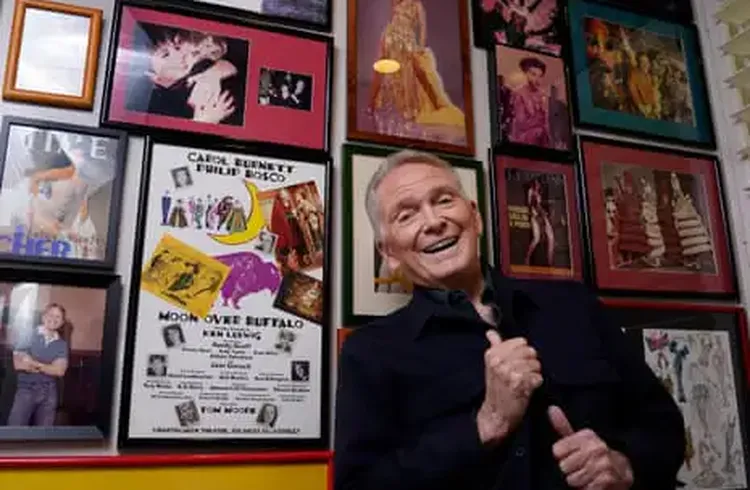
Most costume designers are novelists, supplying character, back stories, social placement and history, done in cloth. Bob Mackie was also a genius cartoonist, assembling details into an image, memorable on sight, that could hold anything from a small 1960s television screen to a concert arena.
Mackie, who has died aged 87, was master of the showbiz sartorial aesthetic that evolved on stage and in films to entertain in itself as well as project performers.
Rhinestones, sequins, beads, plaques, plumes, plush, le tout ensemble. An audience got a big kick from a Mackie costume before a word was spoken or a note was sung, and performers had total confidence in him, as he studied their bodies, movements and personality before designing.
He did that with divas from Judy Garland through Diana Ross, Barbra Streisand, Bette Midler, Whitney Houston, Madonna and, especially, Cher.
Theirs was an interactive relationship from Cher’s television appearances in the 70s, when he guided her out of hippiedom and into minimal material spectacularly styled. He and she plotted the crest of black feathers she wore to the 1986 Academy Awards, atop an outfit that linked back to the extreme exoticism of early movie stars such as Gloria Swanson. What little there was of it was perfectly executed; Mackie costumes were made to couture standards – even his reworkings of second-hand gowns for a broke Tina Turner.
That Cher ensemble was also funny. Mackie’s sharp but not unkind wit shaped performers’ personas as much through humour as glamour. When he dressed Elton John as Donald Duck for a Central Park concert, Elton could barely sing for laughing; he later said Mackie liberated him, let him expand into performance space.
Mackie loved parody, and could crack terrific jokes directly in fabric. His best was one of the thousands of garments he created for Carol Burnett’s TV show though the 60s and 70s. She was playing a spoof Scarlett O’Hara from Gone With the Wind, who had famously sewn a gown from her mother’s curtains. Burnett suggested she could just be draped in curtains, uncut, unsewn. Mackie had her enter wearing the curtain pole across her shoulders as well. The costume is now in the Smithsonian’s collection.
The idea depended on Mackie’s passionate film knowledge. He was born in Monterey Park, on the outer rim of Los Angeles, where cinema was the local industry, the child of Robert Mackie, who worked in a bank, and Mildred (nee Smith). After they divorced, Mildred parked the boy with his grandmother Bessie. Weekdays, he drew. Weekends, he went with his visiting mother and elder sister, Patricia, to the cinema, to watch the many Technicolor musicals that studios confected during the second world war and postwar era from elaborate costumes loosely joined by plot.
Mackie’s favourite stars were Carmen Miranda, the definition of camp from her fruit-crowned head through bare midriff to high platform soles, and Betty Grable, who was kitsch layered in fur and satin, also bare-midriffed. When he noticed there were credits for “costumes designed by” on the 1951 movie An American in Paris, he set out to make that his job.
Mackie attended Pasadena City College and got into Chouinard Art Institute, but dropped out to sell his skills and sketch for LA costumiers. From Jean Louis, who created Marlene Dietrich’s stage costumes, he learned the power of nude soufflé, a sheer silk almost invisible when cleverly lit, yet strong enough to bear heavy beading. Mackie sketched the dress made of it that Louis made for Marilyn Monroe at President John Kennedy’s 1961 birthday bash, and went on using it, in new stretch forms, notably for Cher’s “naked but for the glitter” 1974 Met Gala gown.
He also sketched for the celebrated Edith Head at Paramount. She was dabbling in television, and Mackie turned there too, working as assistant to the talented Ray Aghayan, designing for Garland’s TV shows in 1963-64. They became personal and professional partners, campaigning for an Emmy for costume design.
They won the first one in 1967 for their joint work on a production of Alice Through the Looking Glass, and picked up Oscar nominations for Lady Sings the Blues (Ross as Billie Holiday, 1972) and Funny Lady (Streisand as Fanny Brice, 1975).
Mackie was offered the 1974 adaptation of The Great Gatsby, in part because of the evident research behind his pastiche period clothes for Burnett’s show, but his input into a wide variety of design for weekly, starry TV comedy and music shows was respected, and they drew huge audiences; he turned the offer down.
Mackie received his own Oscar nomination for the movie of Dennis Potter’s Pennies from Heaven (1981), recreating 30s dreamworld lamé and Depression drab; he dressed the film’s ordinary people with great affection.
Disintegrating studios had closed their workrooms of craftspeople, so Mackie and Aghayan had set up their own Californian atelier in 1968 to custom-make for industry clients, and even civilians. At the height of his showbiz fame, Mackie decided to produce actual fashion, and showed ready-to-wear at New York Fashion Week from 1982.
By then, mainstream international couture had already left the salon for theatrical parades of often fantastical garments, yet fashion critics treated Mackie as a vulgar intruder, Mr Hollywood, Barnum Bob. His fashion project lapsed by the end of the decade, except for profitable licensed accessories and a long-running outlet on QVC TV shopping channel. Meanwhile, celebrities began to appear on the new red carpet scene in loaned couture gowns, advertising labels rather than themselves.
Mackie still had faithful clients, especially Mattel’s Barbie. Mattel made at his request a custom Barbie face, without her eager smile, and from 1990 he dressed more than 50 dolls as stately miniatures of his style, some with handsewn embellishment. He had also become, he said, “the patron saint of drag queens”, many of whom had first understood the possibilities of self-fashioning through clothes when viewing his 70s shows. RuPaul proudly wore original Mackie and invited him as a guest judge on the very first episode of RuPaul’s Drag Race in 2009.
Though semi-retired, Mackie remained a pop-culture name, and young showbiz, including Beyoncé, Miley Cyrus and Zendaya, pressed him to borrow archive pieces. He noticed amusedly that European couture had been freely stealing tropes from his oeuvre since the late 90s, but as a guest at the Met Museum’s 2019 camp-themed ball, was amazed that Alessandro Michele, then of Gucci, and John Galliano approached him, moreover tearfully, to tell him he was their idol.
Mackie won seven Emmys, the Council of Fashion Designers lifetime achievement award, and a Tony for the 600 costumes of The Cher Show on Broadway in 2018.
Aghayan died in 2011, as did Mackie’s sister. A son, Robin, from a brief youthful marriage to the actor Lulu Porter (born Marianne Wolford), died in 1993. He is survived by a granddaughter and two great-granddaughters.
Bob (Robert Gordon) Mackie, designer, born 24 March 1939; died 14 September 2026