


Alessandro Costacurta: ‘San Siro Is An Icon – It’s Incredibly Beautiful But It’s Not Functional’
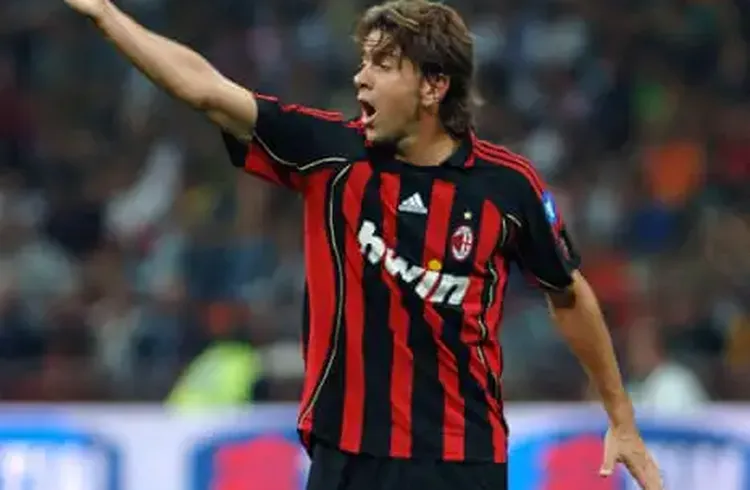
Alessandro Costacurta lasted 15 minutes of his first game at San Siro. He was, admittedly, not playing, but tagging along to watch his older brother’s favourite team.
“I grew up in the province of Varese, north of Milan,” he says. “So as a kid I was a Varese fan. It was my brother who supported Milan. The first time I went to San Siro, I was 12, my brother was 14. I think it was Milan-Bologna. But San Siro wasn’t covered back then, and suddenly this downpour started, so much rain. We were with our dad and after a quarter of an hour he just said: ‘No, that’s it, we’ve got to go.’ So that was the first time I saw San Siro.”
But happily, far from the last. Costacurta was recruited into Milan’s academy a year later and played 663 times for their first team – helping them win Serie A seven times and the European Cup five, either side of its Champions League rebrand. Only his fellow defenders Paolo Maldini (902) and Franco Baresi (719) have made more appearances for the Rossoneri. Many of those were alongside him.
At one point, Costacurta refers to that Milan team as the “best in the world for 25 years”. He quickly corrects himself to “one of the best”. If he wanted to avoid boastfulness then let me say it for him: the back four he formed with Maldini, Baresi and Mauro Tassotti might be – for quality and longevity – the greatest ever.
And they played in one of the planet’s most famous arenas. We are speaking in the days leading up to San Siro’s 100th birthday, an occasion that feels more profound for the knowledge it will not host football games much longer. Milan and Inter completed a joint-purchase of the stadium, and a surrounding parcel of land, from the city council at the end of 2025. They plan to begin construction of a new ground early next year.
A necessary step, for Costacurta. “San Siro is not a modern stadium,” he says. “It’s an icon, it’s incredibly beautiful, but it’s not functional.” He reels off a list of shortcomings, from a shortage of elevators to dated lounges. A mention of the stadium’s infamously grim toilets draws a sheepish grin. “That’s the first thing I wanted to say!”
It will be replaced by a multifunction venue designed by the architect firms Foster + Partners and Manica, with the area around the stadium being regenerated with new retail and hospitality facilities. The realisation of a new stadium has been a central pillar of the vision set out by Milan’s owners, RedBird, since its takeover in 2022.
The project is shared with their co-tenants at San Siro, Inter. There is something in that collaboration that reflects the nature of the rivalry – less bitter than we see between neighbours elsewhere.
“Milan is a particular thing,” says Costacurta. “It’s rare to breathe such friendly air when you go to different derbies around the world. There are chants of course, but also a lot of mixing between fans. And when I was playing, between players too.”
Still, the games against Inter were the best ones to win – especially when your team was officially the “away” one. “When you’re playing in any great team, the biggest satisfaction of all is ‘conquering’ another great team’s home stadium. I remember a 6-0 when we were ‘away’ to Inter [in May 2001]. At 4-0 we could see their fans walking out.”
Construction is intended to be completed in 2031, ready to host games as well at Euro 2032. It will be a boon to Milan and Inter, providing revenue streams that can make them more competitive on a continental stage, at a time when Serie A – like every other league – has struggled to keep up with the Premier League’s earning power.
Even accepting all this, we can acknowledge the sadness of saying farewell to San Siro. Costacurta has visited Europe’s most famous grounds as a player and spectator. What makes San Siro unique, he says, is the steepness of the stands.
“Lots of stadiums are made this way,” he says, holding his hands at a shallow angle. “San Siro is like this.” Now he is pointing his fingers straight downward. “The first time I was out beside the pitch as a ballboy – which everyone does when you get to the youth team – it made me almost afraid. It felt like all those people were going to fall on top of me.”
“Maybe [Real Madrid’s Santiago] Bernabéu is a bit like that. But still, like San Siro? I don’t think so. In Rome, they have a different way of making you feel close – that anthem they sing before kick-off at Roma is beautiful. But it’s different. At San Siro, when you’re up there at the top, it’s like you’re in a tower above the pitch, leaning out of the window.”
San Siro was opened on 19 September 1926, the realisation of the then Milan president Piero Pirelli’s vision for a football-specific stadium unlike anything in Italy at the time. There was no running track, only four stands with capacity for 35,000 spectators.
Pirelli was said to have taken inspiration from stadiums in England, but San Siro was also a product of its setting. Stables, hay barns and storage space were incorporated below the stands to serve the horse racing track next door.
The stadium was bought by Milan’s city council in 1935 and expanded with connecting sections between stands. Inter joined Milan as co-tenants in 1947 before a second tier was added, opening in 1955. In 1980 the stadium was renamed for Giuseppe Meazza, the two-time World Cup-winning midfielder for Italy who played 14 seasons with Inter and two with Milan, though it has remained San Siro to most fans.
Construction of the final third tier, with a roof at last to shield supporters from the rain, was completed before the 1990 World Cup. Costacurta played the first match after its opening, a 1-0 defeat in the return leg of Milan’s Coppa Italia final against Juventus.
“I remember there was more noise, but the main thing I remember is the pitch,” says Costacurta. “They hadn’t understood how to manage the airflow with the extra tier, and the pitch was really ugly. For a year and a half, our pitch was the worst in Europe.”
Clearly, they adapted. Milan went on a record-breaking 58-game unbeaten run in Serie A from May 1991 through to March 1993. Maybe that ugly pitch even became an asset?
“I think it was a disadvantage for visiting teams that came to San Siro,” says Costacurta. “And San Siro is a stadium that puts a lot of pressure on, there’s this incredible noise.”
He switches to the English word, “Roar!”, for emphasis. He’s not wrong. San Siro on a big occasion is astonishingly loud, to the point that you can find it hard to hear people speaking right next to you.
“Nobody’s really talking on the pitch though,” says Costacurta, who insists the real conversations take place on the training ground. Managers bawling from the touchline are engaged in a futile act. “They hope they can pass a message down the line but, trust me, the message almost never gets there.”
But fans have their ways of getting a message across. San Siro still had standing sections when Costacurta made his first-team debut in 1987. “People would be holding onto the railing beside the pitch, sticking their heads out, shouting, shouting, shouting.
“I was lucky because I came through the youth team, so I didn’t take the hardest insults. They said things to me in a Milanese dialect. Insults, but amusing ones. They called me “pè de ghisa”, which means iron foot, because I didn’t have an acceptable level of technical ability for a team like that yet. But my teammates who weren’t from the youth team got proper insults.”
He won them round in the end. Costacurta laughs at the memory of the “rubbish” chant fans made for him. “It was just ‘Billy! [his nickname] Billy! Vai! Vai! Vai!” [Billy! Billy! Go! Go! Go!] The worst chant of any player at Milan.” But on the day of his final game at San Siro, thousands waited outside the stadium to thank him.
Memories like that will always remain, even when San Siro joins him in retirement. Milan and Inter have said that some part of the old stadium will be preserved in the new development. Costacurta, who became a fan of Arsenal over the years too, admiring Arsène Wenger’s teams from affair, finds encouragement in their move away from Highbury, now converted into apartments.
“I played there in the European Super Cup,” he says. “Nil-nil. [Milan won 2-0 in the return leg at San Siro.] Great. Beautiful. Iconic. I think everyone suffered the change at first, but the Emirates is great now. So why not?”